Brooches and pendants are two categories of jewelry whose "presence" is easily underestimated in a store: unlike rings and necklaces, they have no fixed display habit and often lie flat in trays, several stacked together, so customers have to pick through a pile, unable to see the styles clearly or judge the effect of wearing them. A good set of brooch and pendant stands lets these two categories "stand up" and "show off." This article explains how to choose brooch and pendant stands and how to display these two frequently neglected categories so that they get their own showcase.
Start with brooch stands. The core of displaying a brooch is to reveal the pin and stand the piece upright. The upright brooch stand is the first choice: at intervals of a few centimeters on the stand there are tiny sockets or small velvet holes, and when the brooch pin is inserted, the brooch stands steadily on the stand, its face toward the customer, the pin safely tucked underneath, neither pricking hands nor catching threads. Brooch stands come in single-head, multi-head and full-row types by the number of sockets: single-head suits a hero brooch piece, multi-head suits series display, and full-row suits event displays. Without an upright stand, a small velvet pillow works too: insert the brooch diagonally into the pillow to form a natural display angle, and choose a pillow color darker than the brooch to set off its outline. Leave enough spacing between brooches, about two finger-widths between neighbors, so that outlines do not overlap. The depth of the sockets also deserves attention: inserted too shallow, the brooch has a high center of gravity and tilts at a light touch; inserted too deep, the pin buries into the velvet and comes out with effort while loosening the pile. The standard depth is about two thirds of the pin, standing steady yet easy to handle.
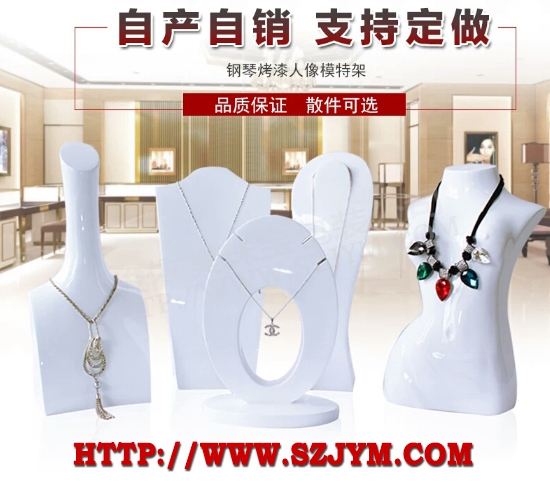
Next, pendant stands. The core of displaying a pendant is to let the piece "hang," showing its drape and dimensionality. The upright pendant stand is the most common choice: the frame carries slim hooks or clips, the pendant ring slips over the hook and the piece hangs naturally, with light from the upper diagonal making the craft details of the pendant face fully visible. Transparent acrylic pendant stands suit layered display, since the clear material does not compete with the pendant's color. Velvet-wrapped pendant stands suit high-end pieces, where the texture of cloth sets off the preciousness of metal and gems. Match the hook height on the stand to the length of the pendant: long pendants on high hooks, short on low hooks, so that the piece hangs at the middle height of the stand for the most balanced look. On the same stand, space the pendants wider than the greatest width of the pieces so they neither touch nor overlap and the eye can rest on each one. One more detail when choosing a pendant stand: for fine-chain pendants use stands with smooth hook mouths, and for coarse chains and leather cords use clip-type stands, clipping above the clasp rather than on the pendant body itself to avoid clamp marks.
Then, where to place the stands. Before brooches and pendants had dedicated stands, they were often dropped into ring trays or mixed trays, squeezed together with rings and earrings, hard to find and messy to look at. Once stands are available, placement matters: place the brooch stand on the middle shelf of the counter at customers' eye level; brooches have strong pictorial impact and belong near the traffic focus. Place the pendant stand where the light reaches, because the luster and craft details of the pendant face need lighting to be presented, and dim corners make pendants look dark and dated. Brooch and pendant stands should be dedicated, not mixed with rings: the handling of the two categories differs, and mixing confuses customers; with dedicated stands, customers know at a glance where each category is, and finding and trying on both feel unhurried.
Next, daily maintenance of the stands. The sockets of brooch stands loosen with repeated insertion and removal, and a loose socket makes a brooch tilt or even fall, so check socket tightness regularly and tighten or replace stands in time. The hooks of pendant stands deform with frequent hanging and removal, and a deformed hook mouth lets pendants slip off, so straighten deformations as soon as they appear. Clean velvet stands regularly with the velvet care methods mentioned earlier, keeping them free of dust and flattening. The language of a stand is "stability": when pieces stand, hang and stay steady, customers can look and try with confidence. A set of brooch and pendant stands in good condition is the best agent for these two categories.
Finally, the "combination display" trick for brooches and pendants. In autumn and winter, the need for wearing brooches and pendants together rises, so display a few scarves or shawls echoing the brooch styles next to the stand, pinning a brooch onto the scarf to show the wearing effect directly. Put a small round mirror and one or two soft try-on pads beside the pendant stand, so customers who take a liking can try on right away; when the try-on experience flows, the will to buy goes up. A stand is not just a shelf for merchandise but a prop that guides customers to "imagine the wearing effect": let the pieces stand up, show off, and pair up, and these two low-presence categories can become favored stars of the counter.