Earrings are the most "alive" category in jewelry. Small on their own — an individual pair lying in a tray hardly registers — but the moment they move, swaying gently under the lights, a customer's eyes follow without thinking. Hanging earrings and making them rotate is the cheapest, fastest display trick a counter has.
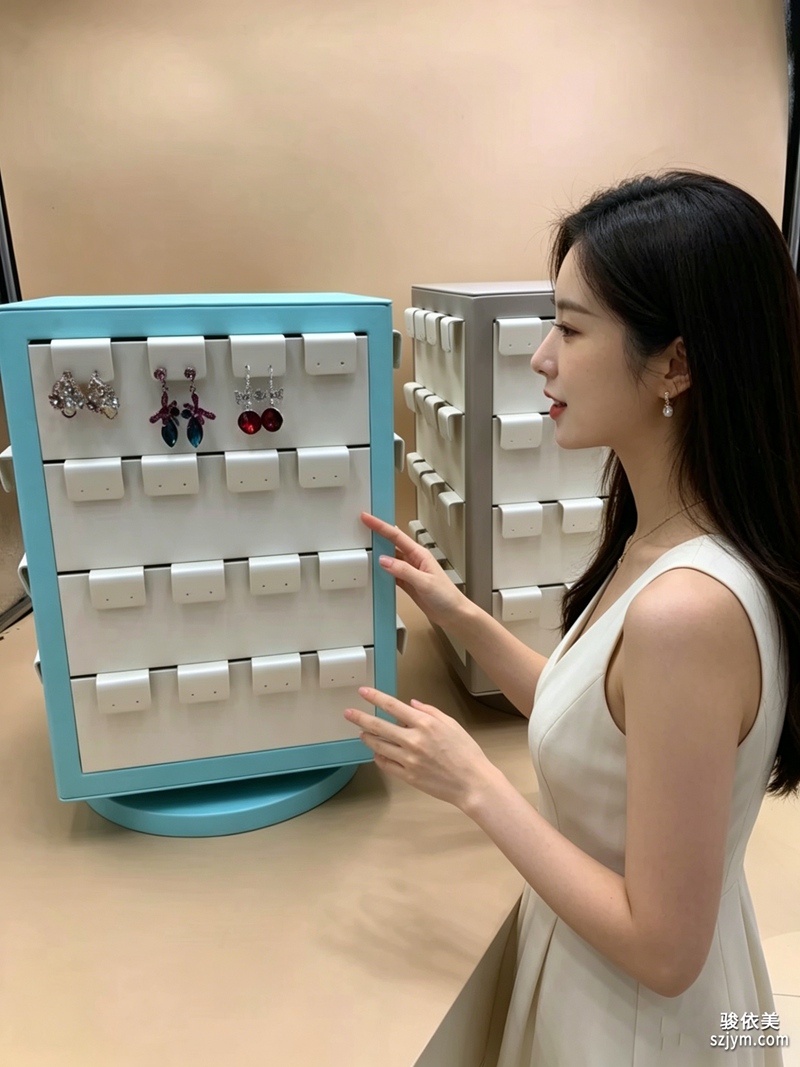
A rotating earring stand does one first thing: it turns "digging" into "browsing." With fixed display, a customer must push through a whole row to see what is behind — two flicks of impatience and she leaves. The rotating stand lets her turn it herself; pairs arrive one by one at eye level, and the physical participation is itself dwell time. She turns it once, twice, eyes staying on the goods — dwell time climbs, and with it the odds of a sale.
Whether a stand works comes down to the axle. Slick rotation, hook spacing, and base weight decide the experience. One pair per hook, spacing neither too dense — or pairs tangle and pulling one catches its neighbor — nor too sparse. The base needs enough counterweight: no wobble, no drift, even when the customer spins it fast. We have seen pretty thin-base stands walk across the counter after two turns; the customer frowns on the spot.
Hanging order has its own logic. Drops on the top tier, studs in the middle, hooks below — light to heavy, top to bottom: heavy pieces low keep the center of gravity stable, light ones up top swing least and never collide. Same-series, same-style pairs share one tier, so a single spin shows the whole season without rummaging.
Load a spinner to about seventy percent: leave two or three gaps in ten, so pairs never tangle and every one gets its “solo shot” as it turns. A packed rail turns into an overwhelming shelf — browsers cannot choose. A single-axle stand typically carries thirty to forty pairs, a double-axle twice that; small shops can start single, while busy main aisles read more like an occasion with double, stretching browse time.
Hook detail and safety decide whether a stand lasts. Use round-tipped, blunt hooks so fine chains and ear-post tips never snag; space rows evenly and leave drop-length clearance so long dangles clear the tier above when turning. Shop safety matters too — a low center of gravity and wide base mean a child's reach cannot tip it, and in a busy store, steady beats pretty.
The stand's material and color should sing with the counter. Metal reads crisp and photogenic for modern counters; wood feels steady beside grain and leather; acrylic is translucent and never blocks a window view. In color, black, white, and raw wood are the safe bets — skip saturated hues, because the goods are the lead and a loud stand demotes the earrings to “support.”
Light is what crowns the spin. With the stand fixed, a tiltable spot from an angle catches each pair at its turn — a bright metal edge becomes the “shutter moment”; straight-down light flattens and robs depth. Distance matters too: too close glares off metal, too far and the edge never appears. After close, kill the spot and keep only ambient counter light — less wear on both goods and stands, and the brightness greets tomorrow as-new.
Placement matters just as much. The best spots are the turn of the customer's walking line or beside the try-on mirror: at a corner the eye pauses naturally, and beside the mirror she finishes half a series while waiting for a friend. As the stand turns, no commentary needed — the customer is pulled in on her own.
Light is the amplifier of a rotating stand. One warm-white spot above, and every pair lights up in turn as the stand turns — the eye follows the light; anything unlit sits in shadow, which is the same as not displaying. The turn should also be quiet — a “squeak” in a quiet counter snaps customers out of “shopping.” Choose a silent-bearing axle and the whole experience levels up.
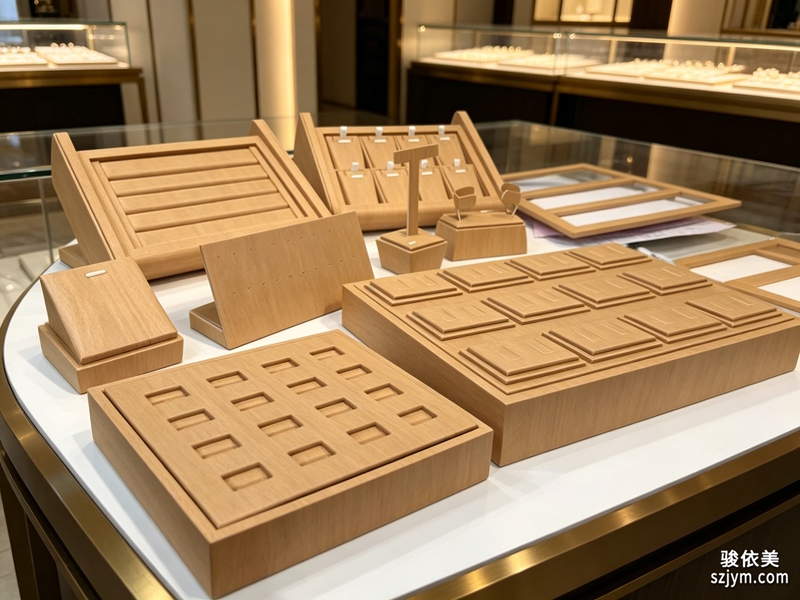
When the stand stands up, its "supporting cast" must match. Wooden trays and slant racks beside it create layering — high and low, the earring zone gains depth. Lay a few hero pairs flat in the tray so she can reach down and try them on. One moving, one still; one standing, one lying — the zone reads rich and professional.
The last brushstroke is sound and scent. A silent, smooth axle keeps the corner hushed like a boutique; a faint sandalwood or cedar diffuser beside the stand buys a few more seconds of lingering, and a few more seconds edge toward the till. These touches take no space and little money — yet they are the final mile of “professional.” Customers cannot name why; they just feel this store is “particular.”
Do the math last. One rotating stand holds about thirty to forty pairs — three to four times a flat tray — and exposure per pair is several times higher, because she is turning and turning means looking. Clip two or three “recommended” tags on the stand, and the heroes stand out while the attach rate climbs.
The stand rotating is not just display — it lets her shop with her hands and lets the earrings speak for themselves. More choices slow her step, and every sale hides inside one of those turns.


